
Electric efficiency: reducing the Carbon Hoofprint in the parlour – Part 2
Listen to this article!
Electric efficiency in the milking parlour continues to evolve as we seek innovative solutions to reduce the Carbon Hoofprint.
In our previous discussion, we highlighted the challenges posed by traditional vacuum pumps and the significant energy consumption that impacts your bottom line.
Now, as we explore further, we'll uncover additional strategies and technologies that not only enhance operational efficiency but also promote cow welfare.
Join us in this journey towards a more sustainable and efficient future for dairy farming, guided by Joao, VP Commercial EMEA-APAC & CX Expert.
Precision pulsation: the low-energy heartbeat
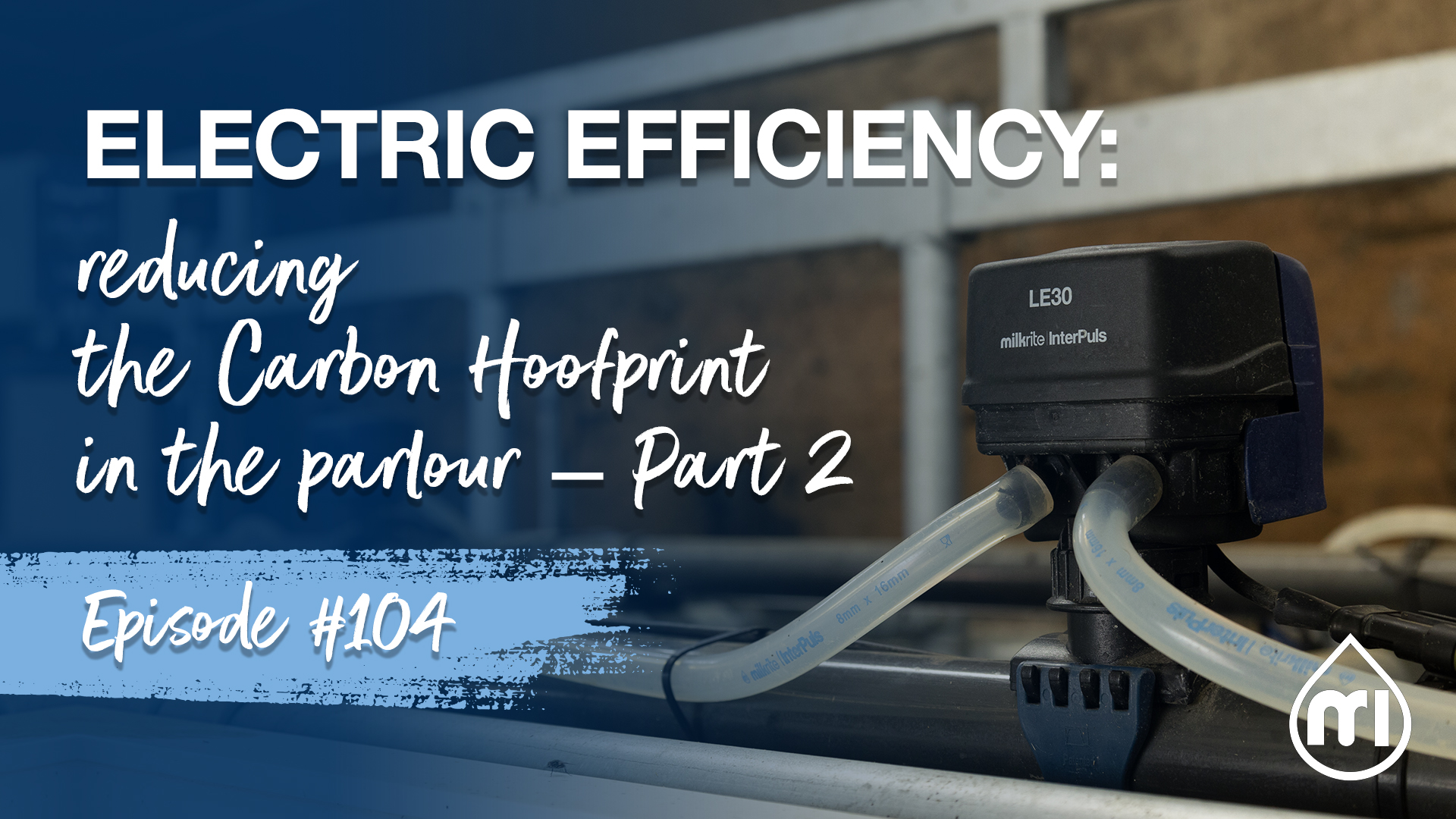
If the vacuum pump is the heart, the pulsators are the machine's heartbeat. We used to use pneumatic (air-powered) pulsation, which was reliable, but clunky and a huge drain on the vacuum. The modern move is toward low-energy electronic pulsation.
You might think, "How much energy can one tiny solenoid use?" Multiply that by 50 or 80 units in a large parlour. Old, high-consumption coils are quietly hogging amperage for hours.
Modern low-energy (LE) solenoids use a "peak-and-hold" trick. They use a quick zap of energy to open the valve, then a minimal holding current to keep it there. It's efficient, runs cooler, and lasts longer.
Crucially, electrical efficiency here equals mechanical precision. A precise solenoid opens and closes on time, making sure the distinct phases of pulsation (A, B, C, D) are crisp.
This is critical for teat health. If a pulsator is electrically lazy, the rest phase (D-phase), when the liner massages the teat end to restore blood flow, gets blurred or shortened. The teat end suffers, and health issues like hyperkeratosis can pop up.
Efficiency isn't just about the meter; it’s about giving the teat sphincter a proper rest! Low-energy, high-precision pulsation ensures the cow leaves the parlor feeling refreshed, not fatigued.
The big energetic paradox
Here's the greatest parlor irony: we spend a small fortune to cool the milk down, and then we spend another small fortune to heat the water up for cleaning.
Milk leaves the cow at about 37°C. To be quality milk, it has to hit 4°C fast. That’s a massive amount of heat to remove. Meanwhile, to sanitize the equipment, we need water that’s 80°C+.
In the old, inefficient way, we pay for electricity to run compressors that remove heat from the milk and vent that heat into the atmosphere. Then, we pay for electricity (or gas) again to heat cold tap water for washing. We are literally paying to throw away heat and then paying to create new heat.
Smart parlours tackle this absurdity from two angles: pre-cooling and heat recovery.
1. The Plate Heat Exchanger (PHE): the first line of defence
Before milk hits the bulk tank, it should pass through a Plate Heat Exchanger. This is arguably the simplest, most effective money-saver in the whole system.
The concept is elegant: warm milk flows one way, and cold well water flows the opposite way, separated by plates of steel. They never mix, but the heat energy transfers instantly.
The simple math: without a PHE, your bulk tank has to drop the milk from 37°C all the way to 4°C, a 33-degree drop.
With a PHE: If your well water is 15°C, a good cooler can drop the milk to near 18°C. The refrigeration unit only has to cool from 18°C to 4°C. We’ve practically halved the cooling workload for free, cutting refrigeration costs by 50%. Bonus: it's better for milk quality by preventing "thermal shock" in the tank.
2. Heat Recovery Systems (HRS): closing the loop
The compressors still have to do the last bit of cooling, but even this waste is now an asset.
Heat Recovery Systems (HRS) capture the thermal energy that the refrigeration unit removes from the milk. Instead of letting the hot refrigerant gas dump its heat into the air, we run it through an exchanger to warm up the incoming wash water supply.
We can pre-heat your wash water to 50°C or 55°C, essentially for zero cost. Now, your water heater only has to bridge the gap from 55°C to 80°C, instead of heating from a cold 10°C tap start.
Combine the PHE (less cooling cost) with the HRS (less heating cost), and you’ve built a Thermal Twin system. That, my friends, is the definition of a circular economy and smart business.
The strategic view: CAPEX vs. OPEX
As executives and farm managers, we scrutinize Capital Expenditure (CAPEX). High-efficiency motors, VSDs, and Heat Recovery units cost more upfront. It’s tempting to choose the cheapest motor to shave a few grands off the initial bid.
But the Operational Expenditure (OPEX) case is screaming louder than ever:
The hedge against crazy: global energy prices are wild. Efficiency is your insurance policy. A farm using 40% less electricity is 40% less vulnerable to the next geopolitical price spike.
Total Cost of Ownership (TCO): over a 10-year lifespan, the electricity cost to run a standard pump often exceeds the purchase price of the pump itself. That "expensive" efficient motor is almost always the cheapest option in the long run.
Future-proofing: Carbon taxes and sustainability mandates are coming. Processors will soon pay more for "low-carbon" milk. Farms that can prove their efficiency will get the premium contracts. Get ahead of the curve.
Conclusion: the quiet revolution
The milking parlor of the future won't be a noisy, power-guzzling beast; it will be quiet, intelligent, and a model of efficiency.
Reducing the Carbon Hoofprint isn't about getting rid of the cows. It’s about refining the technology that supports them. A VSD stabilizes the vacuum for cow comfort. Precision pulsation protects her udder health. Plate Heat Exchangers and Heat Recovery respect the planet's resources.
The goal is a system that is invisible to the cow and gentle on the world. Turns out, the most sustainable way to milk a cow from a physiological, ecological, and financial standpoint, is also the simplest. The switch to smart is in your hands.
MI thanks Joao Pereira for the input.
References
Upton, J., et al. (2020). Energy consumption on dairy farms: A review of monitoring, data analysis, and efficiency metrics. Journal of Dairy Science.
FAO (2019). Climate change and the global dairy cattle sector: The role of the dairy sector in a low-carbon future. Rome.
Reinemann, D.J. (2018). Milking Machine Physics and Performance. University of Wisconsin-Madison.
International Dairy Federation (IDF). Guide to Energy Efficiency in the Dairy Chain.
Bruckmaier, R.M., & Blum, J.W. (1998). Oxytocin release and milk removal in ruminants. Journal of Dairy Science.